
AI doesn't fix bad developers — it amplifies them. If you're a bad coder, you're now producing bad code at 10x the speed. Software fundamentals have never mattered more than they do right now.
There's a narrative floating around tech Twitter that goes something like this: "AI will replace developers. You don't need to learn to code anymore. Just prompt your way to production."
I've been building software for over a decade. I run an AI consultancy. And I'm here to tell you: that narrative is not just wrong — it's dangerous. It's going to cost companies millions of dollars, and it's already starting.
Bad code has always been expensive. But right now, in 2026, bad code is the most expensive it has ever been. And paradoxically, it's because of the very tools that were supposed to make development cheaper.
01The Speed Trap
AI coding tools are genuinely incredible. GitHub Copilot, Claude, Cursor, Windsurf — these tools can generate hundreds of lines of code in seconds. A developer who used to write 200 lines a day can now produce 2,000. That's a 10x increase in output.
But here's the part nobody wants to talk about: output is not the same as value.
A developer who doesn't understand data structures, system design, or error handling doesn't magically become competent because they have an AI assistant. They become a developer who produces bad code 10x faster. The bugs ship sooner. The technical debt accumulates quicker. The security vulnerabilities multiply.
Before AI, a junior developer who didn't understand SQL injection might introduce one vulnerability per sprint. Now they can introduce ten. The AI happily generates the insecure code, and the developer happily ships it because it "works."
02AI Is an Amplifier, Not a Replacement
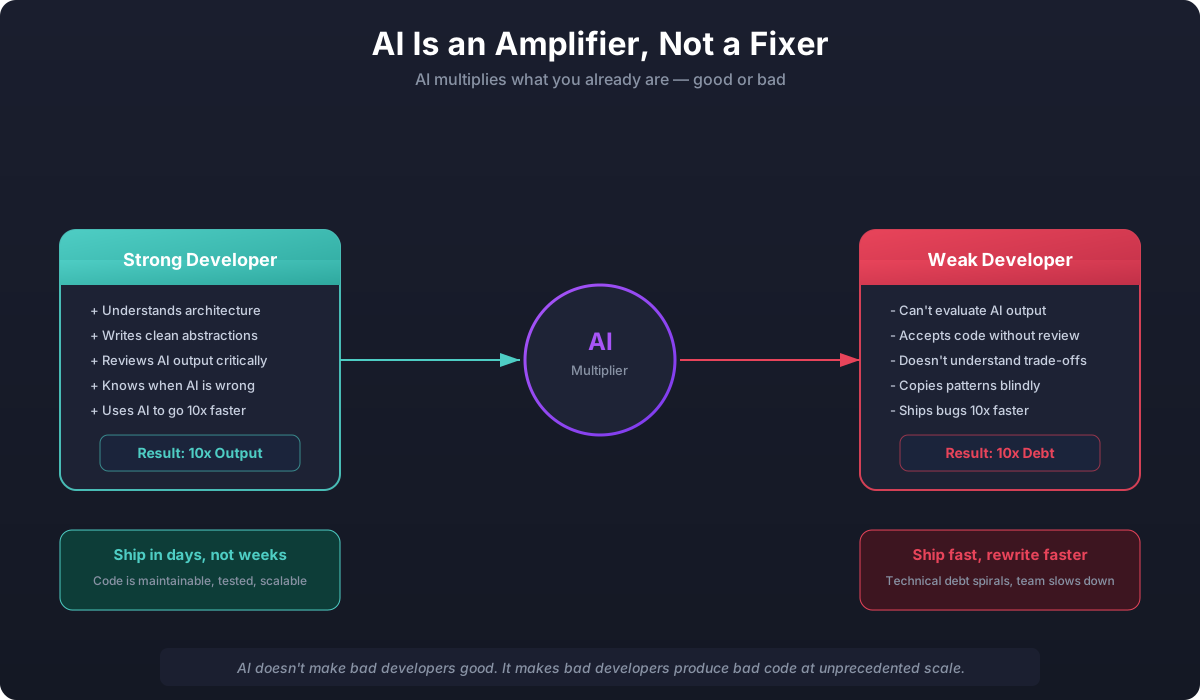
This is the fundamental misunderstanding that's costing companies real money: AI is an amplifier of existing skill, not a replacement for it.
Give a senior architect access to AI tools and they'll design better systems faster. They'll use AI to handle boilerplate, generate test scaffolding, and prototype ideas in minutes instead of hours. They know what good code looks like, so they can evaluate the AI's output and catch the mistakes.
Give someone who has never architected a system access to the same tools and they'll build a Jenga tower of generated code that looks impressive in a demo and collapses under its first real load test. They can't evaluate the AI's output because they don't know what good looks like. Every suggestion looks equally valid.
We see this at Apptivity every month. Companies come to us after their "AI-powered rapid development" initiative produced a codebase that:
- Has no separation of concerns — everything is spaghetti because the developer prompted one feature at a time and never refactored
- Has zero meaningful tests — the AI generated tests that test implementation details instead of behavior
- Has critical security vulnerabilities — the AI generated code that looks correct but doesn't handle edge cases
- Is completely unmaintainable — nobody on the team actually understands how the pieces fit together because nobody designed the architecture
The cleanup costs 3-5x what building it right would have cost. Every time.
03Why Fundamentals Matter More Than Ever
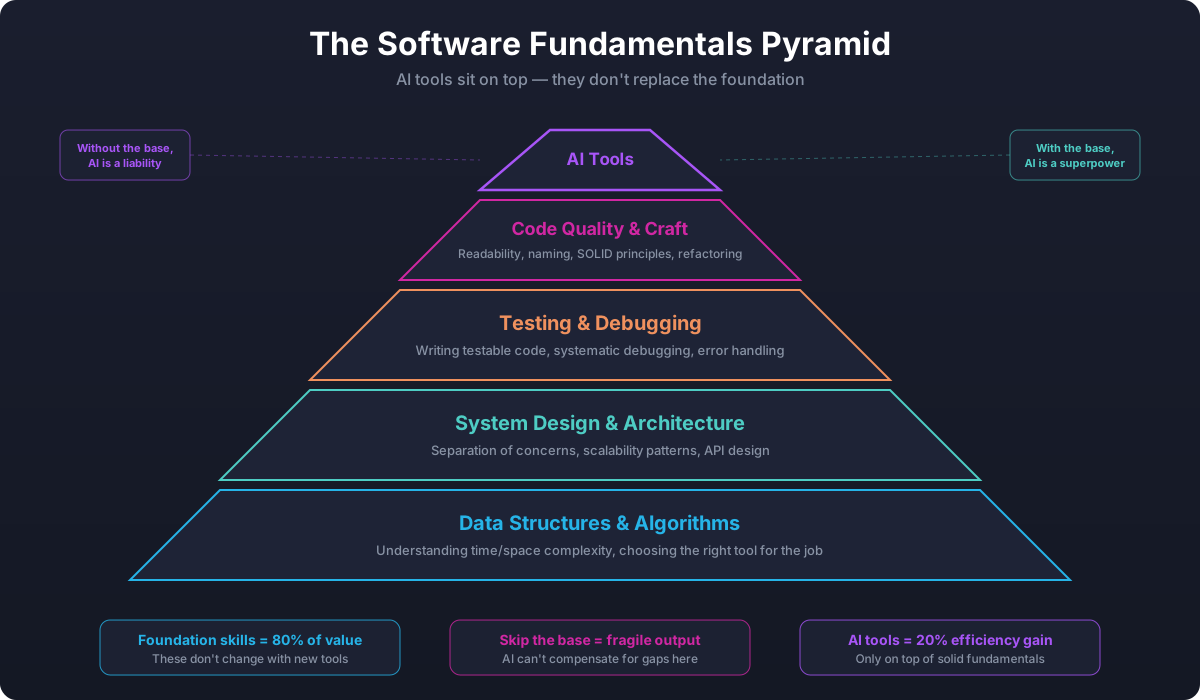
There's an irony here that I find almost poetic: the tools that were supposed to make coding skills obsolete have actually made coding fundamentals more important than at any point in software history.
Here's why:
1. Someone Has to Evaluate the Output
AI generates plausible code. Not correct code — plausible code. The difference between plausible and correct is where bugs live.
If you don't understand time complexity, you can't tell that the AI just gave you an O(n³) algorithm when an O(n log n) solution exists. If you don't understand SQL, you can't spot the N+1 query hiding in the generated ORM code. If you don't understand security, you can't identify that the AI just generated a function vulnerable to injection.
The AI doesn't know your system. It doesn't know your constraints. It doesn't know your scale. A human with strong fundamentals does.
2. Architecture Can't Be Prompted
You can prompt an AI to write a function. You can even prompt it to write a module. But you cannot prompt it to design a system.
System design requires understanding trade-offs across dozens of dimensions: consistency vs. availability, latency vs. throughput, simplicity vs. flexibility, cost vs. performance. These trade-offs are context-dependent and require deep understanding of both the technology and the business.
AI can suggest patterns. It can generate boilerplate for those patterns. But the decision of which pattern to use, and why, requires a human who understands software architecture. Skip this step and you get a codebase that's a patchwork of conflicting patterns — each one reasonable in isolation, incoherent as a whole.
3. Debugging AI-Generated Code Is Harder Than Debugging Your Own
When you write code yourself, you have a mental model of how it works. When something breaks, you know where to look because you understand the intent behind every line.
AI-generated code doesn't come with a mental model. When it breaks — and it will break — you're debugging someone else's logic. Except that "someone else" is a statistical model that can't explain its reasoning.
Developers with strong debugging fundamentals can work through this. They read the code, trace the execution, isolate the problem. Developers without fundamentals stare at the screen, paste the error into ChatGPT, and hope the next suggestion fixes it. Sometimes it does. Sometimes it introduces two new bugs.
04The Compound Interest of Technical Debt
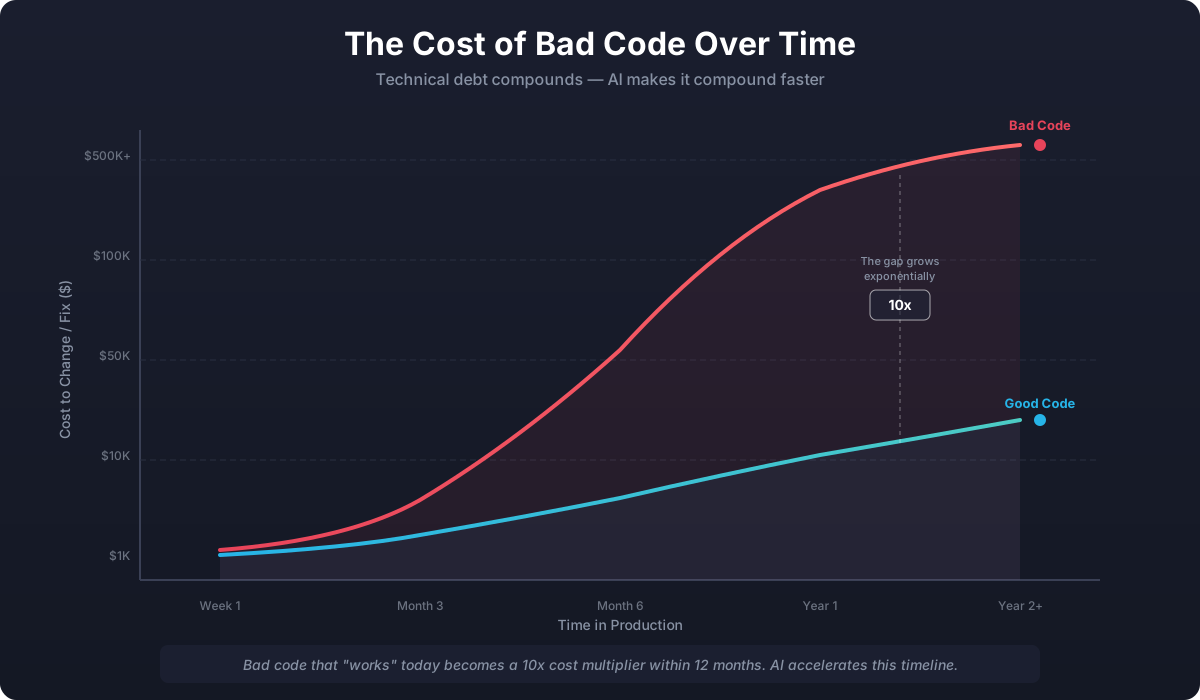
Technical debt has always accumulated compound interest. Every shortcut you take makes future shortcuts more likely and more expensive. But AI has turbocharged this cycle.
Pre-AI, a team might accumulate technical debt at a rate of X per sprint. With AI, they accumulate it at 5-10X per sprint — because they're shipping 5-10X more code, and if the fundamentals aren't there, a proportional amount of that code is debt.
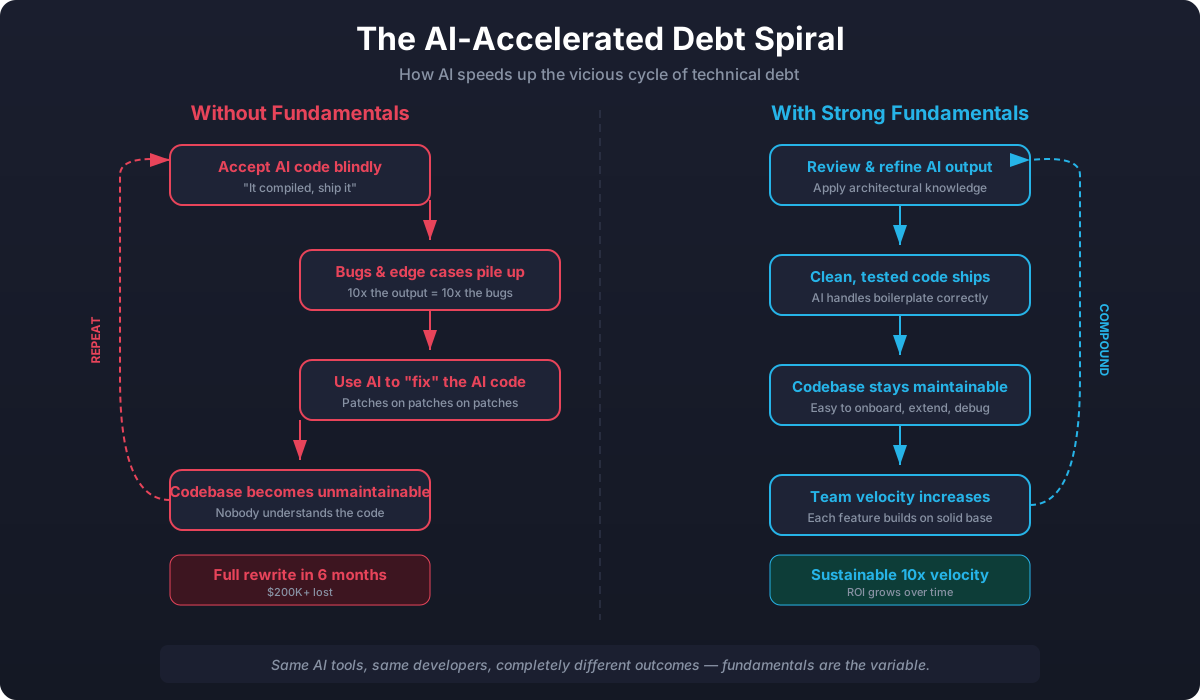
Here's what the debt spiral looks like in practice:
- Sprint 1-3: Ship features fast with AI. Everyone's excited. The demo looks great.
- Sprint 4-6: Bug reports start coming in. Fixes break other things because there's no test coverage and no clear architecture.
- Sprint 7-9: New feature development slows to a crawl. Every change requires understanding a codebase that nobody designed and nobody fully understands.
- Sprint 10-12: The team is spending 80% of their time on bugs and regressions. Someone suggests a "partial rewrite." It always starts as a partial rewrite.
- Sprint 13+: Full rewrite. The AI-accelerated development that was supposed to save six months just cost twelve.
05The Numbers Don't Lie
Let's talk dollars, because that's the language that gets executive attention.
The average cost to fix a bug found in development: $100. The average cost to fix that same bug found in production: $10,000. That's a 100x multiplier, and it hasn't changed with AI.
What has changed is the volume. If AI helps a team ship 10x more code with the same defect rate, they're shipping 10x more bugs. If those bugs make it to production because nobody on the team has the fundamentals to catch them in review, the math gets ugly fast.
A mid-size engineering team (20 developers) producing mediocre AI-assisted code can easily accumulate $950K+ per year in costs from bug fixes, rewrites, security incidents, developer turnover (good developers leave messy codebases), and missed deadlines.
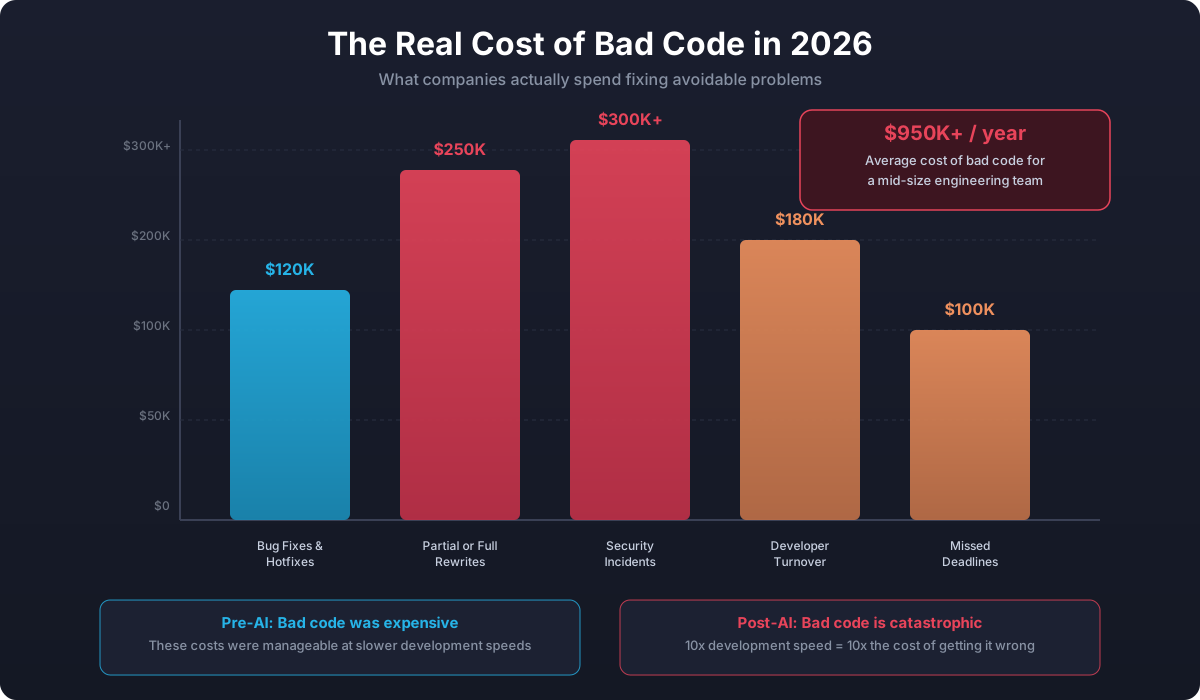
The same team, with strong fundamentals and the same AI tools, ships faster and cheaper. Not because the AI is better — because the humans are better at using it.
06What "Good" Looks Like
So what does a team that uses AI effectively actually look like? In our experience at Apptivity, it looks like this:
They treat AI as a junior pair programmer. They give it tasks, review the output, and refactor what comes back. They never ship generated code without understanding it. The AI writes the first draft; the human ensures it's correct.
They invest in architecture first. Before anyone opens Copilot, there's a system design. There are clear boundaries between modules. There are interfaces defined. The AI generates code within a designed system, not instead of one.
They write real tests. Not AI-generated tests that test nothing meaningful, but tests that encode business requirements and catch regressions. AI is great at generating test boilerplate, but a human has to define what "correct" means.
They do code review religiously. Every PR gets reviewed by someone who can evaluate the code — not just whether it works, but whether it's maintainable, secure, and consistent with the architecture. AI-generated code gets more scrutiny, not less.
They refactor continuously. AI-generated code tends toward duplication and inconsistency because each generation is independent. Good teams refactor aggressively to maintain coherence.
07The Skills That Matter Now
If you're a developer reading this, here's what you should be investing in — the fundamentals that make you more valuable in an AI-augmented world, not less:
- System design and architecture — understanding how to decompose problems, define boundaries, and choose patterns
- Data structures and algorithms — not for interview whiteboarding, but for recognizing when generated code is inefficient
- Security fundamentals — understanding attack vectors, input validation, and secure-by-default patterns
- Testing strategy — knowing what to test, how to test it, and what "coverage" actually means
- Debugging methodology — systematic approaches to isolating and fixing problems in code you didn't write
- Code reading — the ability to understand, evaluate, and critique code quickly
Notice what's not on this list: memorizing syntax, knowing every API by heart, or typing speed. Those are the skills AI actually does replace. The fundamentals are the skills it can't.
08The Bottom Line
Bad code has always been expensive. But the combination of AI-accelerated development speeds and unchanged (or declining) code quality standards has created a perfect storm. Companies are producing technical debt faster than at any point in history, and the bill is coming due.
The solution isn't to avoid AI tools. They're genuinely powerful and the teams that use them well have a real competitive advantage. The solution is to stop pretending that AI replaces the need for software engineering fundamentals. It doesn't. It makes them more important.
If you're a bad coder, AI makes you a bad coder who ships faster. If you're a good coder, AI makes you a good coder who ships faster. The fundamentals are the variable.
Invest in them. Your codebase — and your budget — will thank you.
If your team is shipping AI-assisted code and you're not sure whether the quality is where it needs to be, we do architecture and code quality audits at Apptivity. Thirty minutes with your codebase and we'll tell you whether you're building on rock or sand.